

High atop the royal hill of Aileach, at the gateway to my own fair Inishowen, sits the fort of An Grianan. It is a place of myth and magic, cutting through the mists of time to transport receptive visitors to an otherworldly age… And to hell with how cheesy that sounds; it’s only cliched ‘cause it’s true, goddamit!
In fact, Grianan is so steeped in legend and history that I’ve been putting off this post ever since I started blogging. The only reason I’m writing it now is because I said I would the other day. Why so reluctant? Because there’s so bloody much to say about the place!
How could I describe to you just how utterly amazing it is without telling absolutely everything about it? And how could I do that without boring the arse off everyone bar those with a very particular interest in pre-Celtic Irish monuments? (Or those from Donegal, who’d probably already know everything I had to say anyway.)
So I’ve decided I’m not going to - describe each myth and chronological event associated with the fort right up to the present day, that is. Besides, there’s already a wonderful website and blog dedicated to doing just that, hosted by a lovely German girl I know named Bettina Linke. Ever since Bettina moved to the area many years ago she’s committed herself to the promotion and protection of An Grianan with unparalleled passion. With a book on the way, she’s now even set herself to translating Old Irish poetry about the site in her spare time. That’s dedication for you!
Anyhow, instead of getting bogged down in the details, which is what happened each time I sat down to write this post over the past couple of days, I’m just going to run quickly through the facts and move swiftly on to the folk tales. Those of you still interested in finding out more afterwards can then call over and pay Bettina a wee visit. I’ll try my best to keep this as succinct as possible, though be warned - I do tend to drift when it comes to subjects I care about. Right, let us begin…
In fact, Grianan is so steeped in legend and history that I’ve been putting off this post ever since I started blogging. The only reason I’m writing it now is because I said I would the other day. Why so reluctant? Because there’s so bloody much to say about the place!
How could I describe to you just how utterly amazing it is without telling absolutely everything about it? And how could I do that without boring the arse off everyone bar those with a very particular interest in pre-Celtic Irish monuments? (Or those from Donegal, who’d probably already know everything I had to say anyway.)
So I’ve decided I’m not going to - describe each myth and chronological event associated with the fort right up to the present day, that is. Besides, there’s already a wonderful website and blog dedicated to doing just that, hosted by a lovely German girl I know named Bettina Linke. Ever since Bettina moved to the area many years ago she’s committed herself to the promotion and protection of An Grianan with unparalleled passion. With a book on the way, she’s now even set herself to translating Old Irish poetry about the site in her spare time. That’s dedication for you!
Anyhow, instead of getting bogged down in the details, which is what happened each time I sat down to write this post over the past couple of days, I’m just going to run quickly through the facts and move swiftly on to the folk tales. Those of you still interested in finding out more afterwards can then call over and pay Bettina a wee visit. I’ll try my best to keep this as succinct as possible, though be warned - I do tend to drift when it comes to subjects I care about. Right, let us begin…
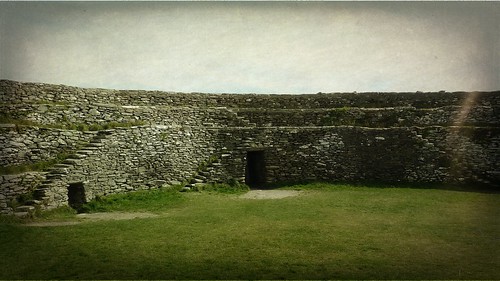
More important than Tara- FACT.
To sum it up in a sentence, An Grianan of Aileach is an iron age ringfort, built on the remnants of a much earlier fortification (thought to be up to 5000-years-old, in your face Pyramids!), with the current stone structure undergoing heavy restoration in the nineteenth-century following it’s destruction during a conflict between two Irish chieftains in 1101. Phew! That was a long sentence. But the place does have a long history, and an important one at that.

Indeed, it is my guess that if it wasn’t for its geographical location Grianan would likely be as famous as Newgrange, and undoubtedly more well-known than Tara. For, just like that other royal hill - and that’s all it is these days, a hill, with hardly any visible fort worth talking about - Aileach too was seat to the High Kings of Ireland at various points over the centuries, and for an even longer period served as the centre of power and culture for all Ulster. (And we still have our fort intact.)
It is also interesting to note that while Grianan shares good company with other sites of high mythological and historical regard, such as Emain Macha, in that it is one of only a handful of Irish locations to be marked on Ptolemy’s 4th century map of the world, Tara gets no mention on the famous document. Mmm…
As I said, the reason most of you have probably never heard of it till now is down to where it is. For one it’s relatively far away from the major airports, and secondly it’s also only a few miles from the border with Northern Ireland, which meant the area was shunned for decades by foreign tourists afraid of getting blown-up. (Kind of silly really considering the chances of getting blown-up in Donegal were so miniscule it was ridiculous.)
Anyway, enough about all that ‘real’ stuff, I want to talk about the stories!
As I said, the reason most of you have probably never heard of it till now is down to where it is. For one it’s relatively far away from the major airports, and secondly it’s also only a few miles from the border with Northern Ireland, which meant the area was shunned for decades by foreign tourists afraid of getting blown-up. (Kind of silly really considering the chances of getting blown-up in Donegal were so miniscule it was ridiculous.)
Anyway, enough about all that ‘real’ stuff, I want to talk about the stories!
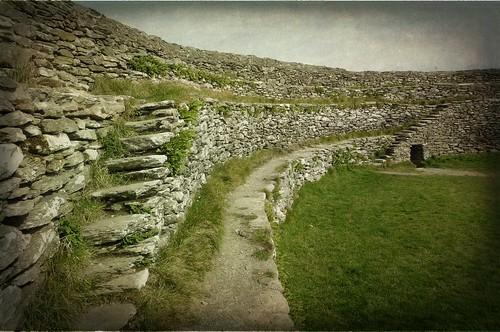
Built by the king of the fairies, no less.
As I’ve said, it would be easy for me to ramble on and on about the ‘true’ history of Grianan, which in itself is pretty darn interesting, but it’s always been the myths and legends surrounding the place which have captured my imagination. And there’s certainly no shortage of them.
The word ‘Grianan’ comes from the Irish word for ‘sun’ and one thing that is agreed upon by archaeologists is that the original structure was most likely built by pagan sun worshipers. That’s fair enough, but it’s who these sun worshipers were that’s most intriguing; ask anyone round here and you’ll only get one answer - An Tuatha De Danann. The Children of Danu themselves.
Now I think I know you, my dear blog readers, well enough at this point to assume that most of you are already well acquainted with this mystical race, and their gods and leaders. Many of you will probably also be aware that they were, in fact, the descendents of Ireland’s fairy aristocracy. (Those who aren’t as familiar with this can find a wee bit more about it in my introductory blog post, and then of course there’s always Google.)
Anyway! One of the most famous tales regarding the origins of Grianan states that it was built by no less than Daghda himself, High King of the Tuatha De Danann who later achieved godly status. The story goes that, following their invasion of Ireland in pre-Celtic times, it was at the hill of Aileach that the Tuatha De Danann first made contact with the natives of their new land. They must’ve liked the spot, or it must’ve already been an area of some significance, for when Daghda’s own son, Aeah, was slew in battle it was here that the god king buried him and built the fort to protect the grave.
Other tales also hint that Daghda’s predecessor, Nuada of the Silver Hand, may also be interred beneath the mound. Indeed, it is what is under the fort rather than the stones themselves that hold the deepest magic and mystery.
The word ‘Grianan’ comes from the Irish word for ‘sun’ and one thing that is agreed upon by archaeologists is that the original structure was most likely built by pagan sun worshipers. That’s fair enough, but it’s who these sun worshipers were that’s most intriguing; ask anyone round here and you’ll only get one answer - An Tuatha De Danann. The Children of Danu themselves.
Now I think I know you, my dear blog readers, well enough at this point to assume that most of you are already well acquainted with this mystical race, and their gods and leaders. Many of you will probably also be aware that they were, in fact, the descendents of Ireland’s fairy aristocracy. (Those who aren’t as familiar with this can find a wee bit more about it in my introductory blog post, and then of course there’s always Google.)
Anyway! One of the most famous tales regarding the origins of Grianan states that it was built by no less than Daghda himself, High King of the Tuatha De Danann who later achieved godly status. The story goes that, following their invasion of Ireland in pre-Celtic times, it was at the hill of Aileach that the Tuatha De Danann first made contact with the natives of their new land. They must’ve liked the spot, or it must’ve already been an area of some significance, for when Daghda’s own son, Aeah, was slew in battle it was here that the god king buried him and built the fort to protect the grave.
Other tales also hint that Daghda’s predecessor, Nuada of the Silver Hand, may also be interred beneath the mound. Indeed, it is what is under the fort rather than the stones themselves that hold the deepest magic and mystery.
Take the little portal pictured below for example, one of several in the interior wall. When we were little the gates weren’t there and we used to crawl inside. My mum used to go crazy at us, though claustrophobia usually got the better of me before I ventured far enough to make her really mad. Now that they’ve been sealed off to curious children and I’ve grown much too large, I often wonder what I would’ve discovered if I’d been a little braver.
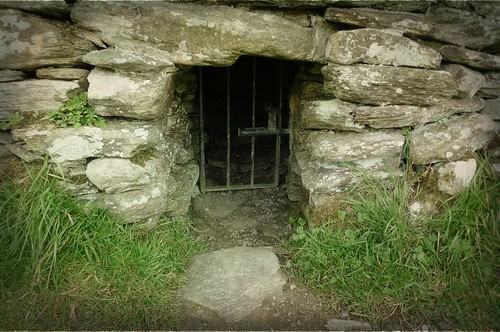
You see another of the local legends of Grianan, and one which is inextricably tied to Irish fairy mythology in general, tells of an extensive network of tunnels that run from these little holes in the wall deep down into the hill. Within there is believed to be a hollow where a band of Tuatha de Danann horsemen still slumber, waiting for the day when “the sacred sword” is removed and they can awake to reclaim their ancient lands.
A more detailed account of this tale can be found here on Bettina’s blog, though as a child I always heard the Irish nationalist version in which the sword was British rule and those inside would only wake once Ireland was united again. Considering Ireland as a whole entity has for the most part only ever been united while under British rule, you’ll have to forgive me if I declare this to be bollocks. ‘Ireland’ of the past was an island of five provinces, those again divided into kingdoms, and not one unified state in the modern sense. But once again I digress…
As you might imagine from it’s name, An Grianan is also associated with other ancient Irish sun dieties such as Lugh and Gráinne, though I’m not going to talk about them now. A little tale I will relate is one from my dad, who often tells of how after a night out partying in his younger days he and a friend decided to go up to Grianan to watch the sun rise. Now it’s very likely considering the context of the story that what he saw may've been in some way influenced from the previous night’s indulgences, but he swears that from his position atop the stone walls he saw the sun dancing in the sky - looping and diving, jumping forward and falling back. In fact, to this day he finds it hard to describe his experiences of that morning exactly. And I’ve heard others tell similar stories so there must be something in it.
Well my friends, you’ll be happy to hear that I’ve finally exhausted myself and have to decided to wrap this thing up now. God, this was a post and a half! Believe me when I tell you I could’ve written twice as much. Anyway, thanks to anyone who stuck with me to the end and sorry for rambling on so much. I just want Grianan to get the recognition it deserves for being so super amazingly awesome.
I suppose every little corner of the world hides it’s own treasures, and we all like to defend our own wee plots. What about you folk, do any of you have any little under-appreciated gems nearby? I’d love to hear about them!


